
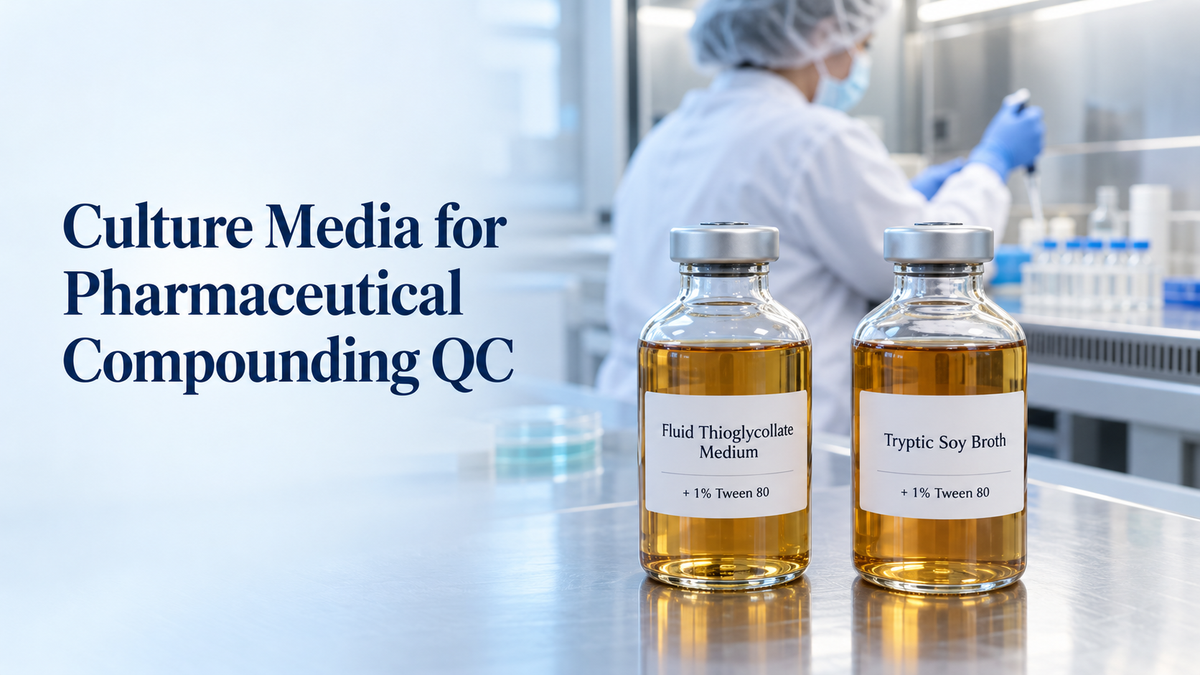
Microbiological quality matters in both sterile and non-sterile pharmaceutical compounding. Choosing a culture medium starts with the preparation being tested and the laboratory’s validated method.
Fluid Thioglycollate Medium + 1% Tween 80 and Tryptic Soy Broth + 1% Tween 80 support different testing needs. They are laboratory testing media, not ingredients to add to compounded medicines.
Fluid Thioglycollate Medium: supporting pharmaceutical sterility testing
Liofilchem identifies Fluid Thioglycollate Medium + 1% Tween 80 for sterility control of pharmaceutical products and cultivation of anaerobic and aerobic microorganisms. Its reducing components create conditions favourable to anaerobic recovery.
Tween 80 acts as an emulsifier for oily or lecithin-containing samples. This can be relevant when evaluating an oil-based compounded preparation, provided the laboratory demonstrates that its chosen method can recover microorganisms from that formulation.
Kormay’s requested format is 25 bottles × 100 mL with flip-off caps. The manufacturer’s catalogue lists this presentation as 453280. Confirm the current batch-specific documentation and closure compatibility before selecting it for your workflow.
Tryptic Soy Broth: microbiological examination of non-sterile preparations
Liofilchem’s Tryptic Soy Broth + 1% Tween 80 supports bacteria and fungi. Its IFU specifically references microbiological examination of non-sterile products.
For compounding laboratories, it may be relevant to enrichment or recovery steps for formulations such as creams, lotions and oral preparations when the applicable method specifies a suitable broth. Further testing is needed to establish organism identity; broth growth alone does not provide a microbial count or identify a contaminant.
Tween 80 helps emulsify oily materials and can counter certain antimicrobial substances. It is not a universal neutralizer for all preservatives or active pharmaceutical ingredients.
View Tryptic Soy Broth + 1% Tween 80 at Kormay.
Demonstrate suitability for the actual formulation
A compounded product can inhibit microbial growth during testing. A clear broth therefore cannot be interpreted in isolation as proof that the product is free from contamination.
The laboratory should establish product-specific method suitability, including recovery in the presence of the formulation and appropriate controls. Depending on the product and approved method, addressing inhibition may involve dilution, filtration and rinsing, or a validated neutralization approach.
Do not assume the modified Tryptic Soy Broth is automatically suitable as the companion medium in a sterility test simply because standard TSB is widely used. Verify the exact formulation against the applicable current pharmacopoeial method and its suitability requirements.
Testing belongs within a broader quality system
Culture testing complements contamination prevention, trained personnel and controlled preparation processes. A passing test does not replace those controls, establish a beyond-use date by itself, or demonstrate the absence of bacterial endotoxins.
For Canadian compounding operations, select testing requirements with your quality lead and the applicable provincial pharmacy standards. Pharmaceutical manufacturing requirements should not automatically be treated as identical to pharmacy compounding requirements.
Selecting media with Kormay
Contact Kormay to discuss bottle formats and request available IFUs, safety data sheets and batch quality documentation. Have your laboratory confirm the selected medium’s suitability for the intended application before use.